Fair Shares in the Dark: Rethinking the Household Dog-Walking Rota
Photo: Robin Stott , CC BY-SA 2.0, via Wikimedia Commons
November has a way of shrinking the day. By the time the afternoon school run is done and the kettle has gone on, the light is already sliding away. In many UK households, that is the moment the same person reaches for the lead—again. Not because anyone has decided it should be that way, but because a routine has quietly hardened into a rule. The default walker trap is rarely dramatic. It is built from small, reasonable-looking choices that stack up until one person is carrying the dog's entire outdoor life.
The quiet drift into default
Default walking seldom starts with an announcement. It starts with 'I'll just do it tonight' or 'you're better at the busy route than I am'. One person learns the dog's little habits: the hedge that must be sniffed, the cat on the corner, the patch of pavement that gets skittish after rain. That knowledge is useful, but it can also become a trap. The more competent one person looks, the less anyone else feels invited to step in.
Before long, the household has a walker rather than a walking plan. The dog is fine with it, mostly. Dogs love routine. But the person holding the lead may be quietly running on empty, especially when winter turns every evening walk into a torch-lit expedition.
Work patterns are not the enemy—invisible work is
It is easy to blame shifts, commutes and hybrid working. Those things matter, but they are not the whole story. The real friction often comes from work nobody has named: checking the weather, finding the torch, refilling the treat pouch, remembering that the harness rubs, noticing the dog is slightly stiff after a long lie-down.
A fair rota does not need to be perfectly equal every day. It needs to be visible. Try looking at the week rather than the day. One person may have early starts on Tuesday and Thursday; the other may have a late finish on Wednesday. Build the walks around real capacity, not an imaginary fifty-fifty split. 'You did three, I did two' is less useful than 'we both know who is on lead tonight and who is on tea'.
Dark evenings change the maths
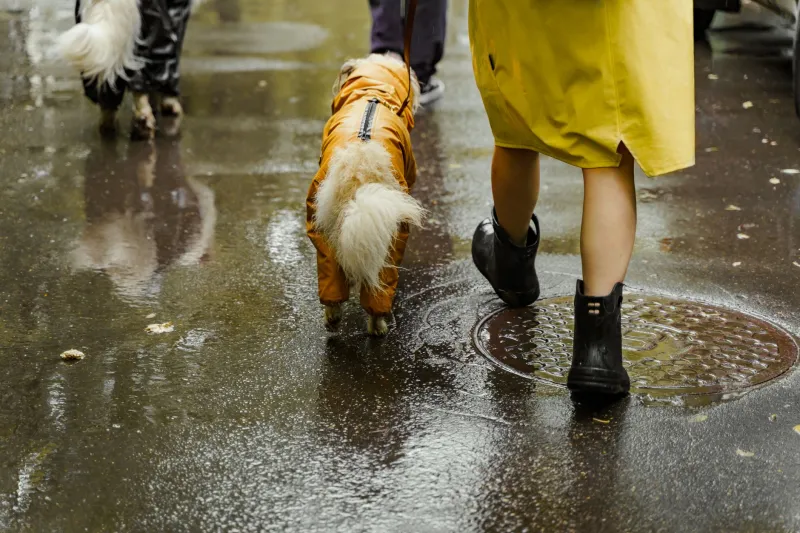
Winter walks ask more of the person doing them. There is the hi-vis coat, the charged torch, the safer route and the extra minute spent towelling paws at the door. When the same person does the dark walk every night, small burdens become heavy ones.
A simple swap can help. One person takes the morning walk; the other takes the 4pm or after-dark slot. Or trade evenings midweek: you do Monday to Wednesday, I do Thursday to Friday, and we choose the weekend routes together. If one person genuinely cannot do evenings, they can own the other visible jobs—drying the dog, refilling the poo-bag stash, booking the groomer, checking the forecast. Fairness is not only about who is outside. It is about who is holding the whole picture.
Keep the dog's routine steady, not rigid
Dogs cope best with predictable rhythms, but they do not need the same human every time. Consistency of cues matters more than consistency of face. If one person uses 'wait' at the kerb and the other says 'stop', the dog has to learn two languages. Agree on a handful of household cues: wait, this way, leave it, settle. Keep treats in the same place. Use the same harness and lead so nobody is guessing at the door.
A short handover note can save a lot of low-level friction. It does not need to be a diary. A note on the phone or a wipe-clean board by the door is enough: 'Slight limp on back left after the park—kept it short.' 'Bin day tomorrow, avoided the lorry.' 'Ran out of poo bags—new pack in the cupboard.' These notes are not bureaucracy. They are how a shared dog feels looked after by everyone.
Warning signs of walker burnout
Walker burnout rarely looks like a dramatic collapse. It looks like dread at 3.30pm. It looks like rushing the dog past every interesting sniff. It looks like snapping at the lead, skipping the evening walk, or feeling secretly relieved when it rains. Physical signs matter too: aches, disturbed sleep, a low-grade resentment that has nowhere to go.
If any of that sounds familiar, treat it as information rather than a character flaw. The answer is not to push harder. The answer is to redistribute the load before the dog notices the change in atmosphere.
Build a rota that bends without breaking
At Pack Buddies, we like a rota that is clear enough to be fair and loose enough to survive real life. Have a ten-minute check-in each Sunday. Name the default walker for each day. Name a backup. Agree how to swap without a debate. Keep the dog's core routine—meal times, bedtime, the general shape of the day—steady, and let the humans be flexible around it.
The goal is not a perfect spreadsheet. It is a household where the lead gets picked up by different hands, where the dog still knows what to expect, and where nobody quietly becomes the only person who ever walks the dog. Fair shares in the dark are possible. They just need to be talked about before the torch battery runs out.