Fewer Leads, Better Walks: In Praise of the Deliberately Small Pack
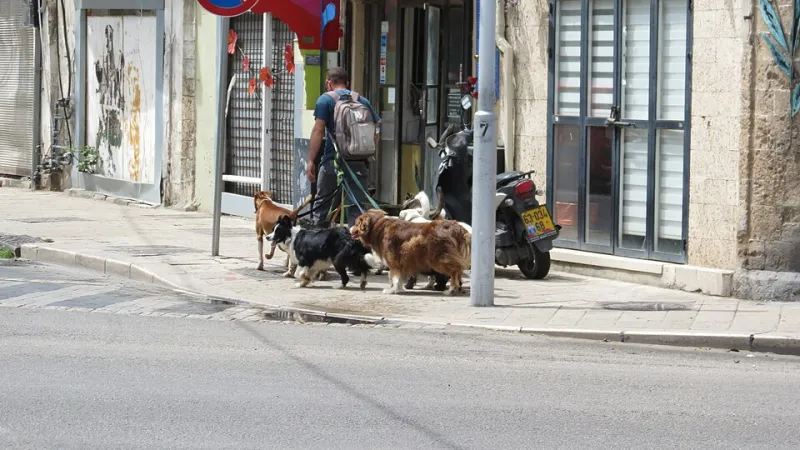
Photo: Hoshvilim, CC BY-SA 4.0, via Wikimedia Commons
Stand by any popular park gate on a bright Saturday and you'll spot them: one person, six leads, a weaving knot of noses and tails moving at three different speeds. It looks cheerful. It photographs brilliantly. And then someone spots a squirrel, and the whole thing becomes a shunt on a pavement.
This is an opinion piece, so let's be honest about the opinion up front: for most walkers, on most routes, three dogs is about the sensible ceiling. Not because four is wicked, but because attention is finite and a walk is a series of small decisions made quickly.
Three isn't a magic number, it's a working one
Nobody is handing out certificates for arithmetic. A calm, well-established trio of older collies on a quiet footpath is a different proposition from three adolescent spaniels on a Saturday high street. The point of the three-dog rule is less about the number and more about what the number protects: your ability to see everything, respond early, and still have a hand free for a gate.
So treat three as a starting budget, not a law. Some walkers can hold four comfortably because the dogs are older, the route is familiar and the recall is drilled. Others should stop at two. The rule is really a prompt to ask the question at all, which the industry rarely does.
Attention is the currency, and it divides fast
Watch a professional walker with a large group and you can often see the split-second where the maths goes wrong. Two dogs are sniffing at the back, one is pulling towards a bench, and the lead dog has spotted a cyclist on the towpath. That's four things and one pair of eyes.
With three dogs, you can usually keep everyone in peripheral vision and still scan ahead. With six, you are mostly reacting. Reacting is fine until the day it isn't.
Recall in the real world, not the training field
Recall is where small packs earn their keep. A dog that comes back nine times out of ten in the garden is not the same animal as a dog that comes back nine times out of ten with five friends racing around a field.
In a group of three, you can rehearse recall properly, because you can see the moment each dog considers ignoring you. You can reward the one that turns first, which is quietly the most powerful training tool available to a group walker. In a group of six, the one that turns first is often already lost in the noise.
Roads, gates and the bits you can't plan for
UK walking is full of pinch points: kissing gates, stiles, narrow pavements beside an A-road, the corner by the village shop where everyone parks badly. Each of those is a small logistical problem that scales with headcount.
A three-dog pack can be moved through a gate in one smooth motion. A six-dog pack means somebody is always briefly on the wrong side of the gate, and briefly is all it takes. Add a wet November afternoon and a delivery van reversing and the difference between three and six stops being abstract.
The owner update that writes itself
Here's an underrated benefit: smaller packs produce better communication. When you've walked three dogs, you can tell each owner something specific, because you actually saw it. Not 'he was fine' but 'he hesitated at the metal drain cover again, then walked past it on the second go.'
Owners notice the difference between a report and a receipt. A walker juggling eight dogs can only offer a receipt.
Signs the pack is well matched, not just well attended
- The group settles within the first few minutes rather than circling for half the walk.
- Leads stay loose on the way to the park, not tight and criss-crossed.
- No single dog is permanently at the back, dragging or being towed.
- You can stop to talk to a neighbour and the pack waits with you.
- Recall works even when the third dog breaks ranks first.
- There's a natural front, middle and rear, and it's stable week to week.
If any of those are missing, adding a fourth dog won't fix it. It'll just add a witness.
When more is genuinely fine
An honest piece has to admit the exceptions. Long-established groups of older dogs on private land, or a secure field hire where leads come off and space is generous, can comfortably hold more than three. Likewise, a walker with a second experienced handler is effectively running two small packs side by side, which is the whole point.
The trouble tends to arrive when a large group is loose on public ground with one pair of hands and a route that has to cross a road twice.
What this means in practice
If you're choosing a walker, ask how many dogs go out together and what happens when the number grows. A good answer sounds boring: we cap it, we match energy levels, we walk the same route so the dogs know the rhythm. A less good answer involves the phrase 'they soon get used to it.'
If you're the walker, the small-pack habit pays you back in calmer dogs, faster recalls and clients who trust your updates. It costs you a little revenue per hour and saves you an awful lot of incident reports.
Three isn't a rule anyone will enforce. It's just a nice round reason to keep your eyes where they need to be: on the dogs, and ahead.