Pavement Politeness: Six Everyday UK Stops That Build Brilliant Dog Manners
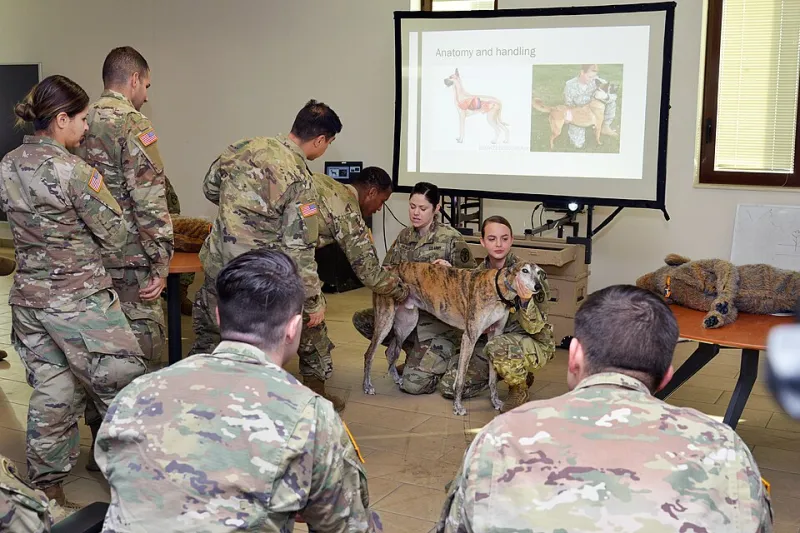
Photo: U.S. Army TSAE by Paolo Bovo, Public domain, via Wikimedia Commons
There is a particular kind of dog-training fantasy that involves a quiet field, a long line and a whistle. It is lovely while it lasts. But most of us live on pavements, outside corner shops and beside school gates, with a bus due in four minutes and a dog who has just spotted a chip wrapper. The good news is that real-world manners are not built in perfect conditions. They are built on ordinary walks, repeated calmly, with rewards that make sense to the dog.
Think of your local route as a syllabus. Not a formal one, and certainly not a test. Just six everyday stops where you can practise one small thing at a time. Keep sessions short, keep the treats close, and remember that a dog who can settle by the café queue is not showing off. They are learning that the world is manageable.
Bin day: loose lead and calm curiosity
Bin day is a UK dog-walking classic: clattering lids, unfamiliar smells, a lorry that appears without warning. Use the noise as a chance to practise distance and check-ins. Stand well back from the action, let the dog look, then mark and reward when they turn back to you. If the bin lorry is too much, increase the distance until the dog can notice it without lunging.
For loose-lead practice, reward the slack. Every time the lead hangs loosely for a few steps, say 'yes' and treat. Do not wait for a perfect heel. You are teaching the dog that walking near you pays better than dragging towards the bins. Keep the route boring and the rewards generous.
The bus stop: neutrality practice
Bus stops are excellent for teaching a dog to be neutral around people, bags, wheelie cases and the mild chaos of waiting. Find a bench or wall a few metres away and simply sit. Reward your dog for looking at the world and then looking back at you. If they can lie down, reward that too. If they cannot, standing calmly is enough.
Do not let every stranger pet the dog. Neutrality is the goal, not celebrity. A dog who can watch a queue form without feeling the need to join it is learning a skill that will serve them well at the vet, the café and the train station.
The school gate: recall and impulse control
The school gate is busy, noisy and full of small people with interesting snacks. It is not the place to test a shaky recall from scratch. Start further away, in a quieter spot, and practise your recall cue with easy rewards. Then move a little closer over several days.
One simple drill is 'find me': say your dog's name, reward when they turn, then take a few steps backwards and reward again as they follow. Keep the dog on lead near the gate. The lesson is not 'ignore the children'. The lesson is 'checking in with my person is worthwhile even when there is a lot going on'. If the gate is too chaotic, walk past on the other side of the road and reward calm observation instead.
Café queue: settling and patience
A café queue is a masterclass in waiting. Take a small mat or towel if your dog has one, and reward them for lying down beside you while you order. Start when the queue is short. Give a long-lasting chew or a scatter of treats on the mat. If your dog gets up, reset gently and reward the next lie-down.
Do not feel you have to stay for a full brunch. Two minutes of settled behaviour is a win. The point is to build a positive association with busy places, not to prove your dog can handle a three-course meal. If they are over threshold—barking, straining, unable to take treats—step outside and try again another day with more distance.
Narrow park path: loose lead and yielding
Narrow paths are where good pavement manners show. Practise 'this way' when you need to step aside for a jogger, a pram or another dog. Reward your dog for coming back to your side and for walking beside you rather than ahead. If another dog is approaching, create space early rather than waiting until you are nose to nose.
A simple game is to reward every glance back at you on a tight section of path. You are not asking for military precision. You are asking for a dog who can share a small space without turning it into a tug-of-war. If your dog is easily overwhelmed, choose wider routes and build up slowly.
Vet car park: happy associations and handling
The vet car park is not just a place you pass through in a crisis. It can be a training stop in its own right. Visit without an appointment, sit outside for a few minutes, and reward your dog for calm behaviour. Let them sniff the car park, eat a few treats, and leave. Repeat this on a quiet day.
You can also practise gentle handling: a quick look at ears, a treat, a touch of the paw, a treat. Keep it brief and cheerful. The aim is to build a dog who associates the vet building with treats and predictability, not just with thermometers and waiting rooms.
Ordinary walks, extraordinary manners
None of these drills requires a training field or a free weekend. They require a pocket of treats, a little patience and the willingness to use the walk you were already doing. Real-world manners are built in the middle of real life: at the bin store, by the bus stop, outside the school, in the café queue, on the narrow path and in the vet car park.
Keep sessions short. Reward what you like. End before your dog has had enough. And remember that a dog who can be polite on an ordinary UK pavement is not a dog who has been drilled into perfection. They are a dog who has learned, one small stop at a time, that good things happen when they stay connected to their person.